Friday, December 29, 2006

Insights in to an Indian melting pot: Gujarat State

I have been enjoying learning more about the Gujarat region of India. Northwest of Mumbai and south of the Indus River and Pakistan, Gujarat enjoys an expanding economy. As more and more of the region benefits from economic globalization, we start to see a Gujarati presence on social networking websites such as Flickr. Get a taste of this new landscape by searching Flickr for "Gandhinagar," or visit the website for Infocity, Gandhinagar.

In the post-independence period, India had the challenge of creating capital cities that didn't celebrate authority and imperialism, but rather allowed for the growth of democratic values. Professor Ravi Kalia of City College, CUNY has recently published a book called that explores the difficulties that Gujarat State faced in designing its new regional capital Gandhinagar, responding to local cultures in the modernist architectural idiom. You may be interested in seeing a video lecture where he discusses these perspectives.

Photo bloggers such as Japan Pathak have been quite patriotic in sharing insights into this region through the internet. While the region is very hot and dry, during the rainy season we can also see flooding, as demonstrated in this photo posted on Flickr.


Sabarmati river flood in Ahmedabad - My one of the best click during flood 2006
Originally uploaded by japan pathak.

You may also be interested in checking out gujju rap's meditation on the modernist and traditionalist pulls that one finds in this region.

Sunday, October 15, 2006

Podcast on Globalization and the Rise of Religion

I am blogging while listening to this week's "Speaking of Faith" podcast, featuring interviews with sociologist of religion Peter Berger and Harvard business professor Rosabeth Moss Kanter. The program offers a fascinating overview of currents that have become more noticable since 9/11, with discussions of the 'clash of civilizations' and the globalization of different religious faiths.

I think back to my graduate school experience during the early 1990s and reflect that indeed Peter Berger's earliest views on the place of faith in the modern world were also characteristic the readings and discussions that we engaged in as students. Modernization tended to be equated with the rise and spread of secularism. We must not have been aware of how Eurocentric this perspective was. The fact that this emphasis continued amongst participants in the Committee on Social Theory in spite of all of the growing evidence to the contrary tells you something about the interests and world view of the American intelligentsia esconsed in university towns. It is worth noting that this was also my own worldview created as a result of growing up with a father who as a university professor and a mother who was an active faculty wife, in college towns like Columbia, Missouri and Columbus, Ohio.

Conversation with Peter Berger: Instead, what Peter Berger has found is that modernization and globalization have spurred the spread of religion in a way that is transforming its practice. Countries and regions that haven't had to grapple with with religious diversity in the past are now forced to do so. Pluralism presents a challenge to the old religious groups including mainline Protestantism. This doesn't mean that these faith traditions need to be abandoned, that that religious practice needs to become more intentional - see the exciting new book by Diana Butler Bass, Christianity for the Rest of Us, for which presents a number of case studies for liberal churches that have followed this path and thrived. [She recently blogged about the birth of a new media-savvy group called the 'Red Letter Christians.'] Religions of all kinds are losing their taken-for-granted status. Rather than growing up in a faith community that offers the necessary structure, people are now forced to make choices. This is a very big change and offers quite a burden for people. What are the ways in which people can cope with the loss of this taken-for-granted status? People respond in three ways.

1. Stay in your faith, but enter into dialogue with the alternatives that exist. Difficult but possible. [I wonder if the faith that I currently practice, Unitarian-Unitarianism, offers the best or even a preferred opportunity for this. We lead the curve in this movement, but now find ourselve without a core body of believes. Faith by committee.] Berger observes that these exchanges don't have to take place in elite settings, and offers the anecdote of his 5-year old granddaughter chatting "across the fence between houses in suburban America." He observed a fascinating conversation unfold with the other 5-year old girl from across the street - Hindu and a Jew for Jesus coming to terms with one another.

2. Create sectarian subcultures, in response to pluralism. These little groups must maintain tight control. I think here of the role of the mosque for itinerant Senegalize traders in New York City.

3. The third form of response is to attempt through cultural and political force to reinstitute one belief system for the state. The Eastern Orthodox Church is trying to reinstitute its authority, within Russia, along the lines of the long established model of church, state and society operating together as a symphonia. The establishment of state religion is an ongoing project througout large portions of the Islamic World.

Conversation with Rosabeth Moss Kanter: What role should religion play in business settings? At the beginning of the semester, she asks the students in her courses to send her an email describing a little bit about themselves that they think their professor should know. In the past, students who introduce themselves would devote most of that space to discussing their career trajectory. But this past year, many wrote about faith and the role that it played in their lives. Religion also appears to be playing a much stronger role in discussions in corporate America and at world economic fora.

Much more of these fascinating conversations can be found at http://speakingoffaith.org and the specific program website. Don't miss the excellent annotated program guide.

Saturday, September 30, 2006

TED: Majora Carter (2006) video

Majora Carter is the Macarthur-winning founder of Sustainable South Bronx, an organization dedicated to holistic community development, sponsoring projects that create jobs, protect the environment and bring beautiful green space to the inner city. In this charismatic presentation (which received a prolonged standing ovation), she explains the inspiration behind her commitment to environmental justice and her vision for a renewed South Bronx. [Recorded February, 2006 in Monterey, CA]

Thursday, August 03, 2006

Map of the Liberian coast, 1831


Finley map liberian coast 1831
Originally uploaded by Edu-Tourist.

Since returning from Jamaica my travels have been a little bit closer to home. In my spare time (or when I need a distraction, I like to hunt down historic maps on the Internet. This image is taken from an atlas for school use produced by a Philadelphia cartographer in 1831. It is so interesting to read the place names that the American colonists gave to the Liberian coast. Many of them, including the city of Philadelphia, exist to this very day. Too few Americans realize our historic ties to this region, and I have only had a chance to learn more about them since I have become a faculty member at Temple University in Philadelphia, PA. Think of the emphasis in different American schools in the early 1830s - the stories that teachers would be able to tell (if they chose to) about revolution in Haiti and colonization in Liberia. We would do well to remember these historic ties and the lessons they (should have) taught us during this current period of expanded American imperialism.

Sunday, June 18, 2006

Thanks to everyone for a great trip!


lighthouse group2
Originally uploaded by Edu-Tourist.

I'm finally back in Philadelphia for good (at least until we pick up the moving van) and am finally able to find the time and the bandwidth to catch up readers with some of the wonderful stories accumulated during our month in Jamaica. There were too many highlights to the trip for me to be able to pick one. So you are just going to have to suffer as I share these several stories over the coming weeks. Special thanks to Nelson and Novella Keith for hosting the group of Temple University students at Carleva Bay: The Center for Global Understanding.

Special thanks as well to Peter Thompson and the staff of RADA's office in St. Thomas. Temple students Jillian Blair and Matthew Borda always enjoyed their trips into the field with Mr. Brown. Some of our more ambitious tours of the region were led by Mr. Colan Parke. Keep an eye on this space for discussion of the difficult state of infrastructure and drainage in the parish as hurricane season comes around again, based on the stories and testimony of our own eyes in the Yallahs River and Negro River watersheds.

Mr. Park also introduced us to the wonderful and engaging guide Bev Smith, a community organizer in Eastern St. Thomas who is developing heritage tourism materials and exhibits to welcome the expected influx of visitors next year. Bev Smith organized a spendid cultural trip of the region on bahalf of the Edu-Tourism staff and students. Early in the morning we drove right of the hill behind Yallahs to visit Orange Park, the old estate house renovated by famous Jamaican artist Barrigton Watson. We enjoyed seeing what he had done with this former coffee plantation. Later that afternoon, we were able to drive all of the way out to Point Marant, the furthest eastern location on the island of Jamaica. Here sits the amazing cast iron lighthouse installed in the 1840s. As you can see from the photo, the lighthouse now runs on solar energy cells that recharge batteries in the lighthouse and keep the beacon lit, stearing vulnerable vessels away from the shoals.

Friday, June 09, 2006

Edu-Tourism in Jamaica - Report #3

Hello everyone: As our return to Philadelphia approaches, I would like to take some time to update you all on the various sorts of activities we have been engaged in. So expect a flurry of blog posts here. As before, I will begin with a summary of our daily events, and follow with more in-depth description and analysis. More pictures shortly.

Wednesday, May 24, 2006 - Working at various sites.
Mike, Matthew and Jillian had a long meeting in the RADA office with assistant director Peter Thompson. He provided us with a good overview to RADA operations, and how they seek to develop partnerships with different community groups. After a discussion of various projects that we might be able to assist with, Mr. Thompson drove us out to see a fledgling project in a community called Airy Castle, called the St. Thomas Women’s Agricultural Initiative. We arrived there just in time to observe their business meeting. Seems to be conducted very professionally. A banker from PNC Bank (“The Farmers’ Bank”) had been invited to the meeting to explain the process by which the farmers would be able to save money for the future (individually and as a group). After the meeting I took a look at their computer and noted that they don’t have any useful office software. Peter Thompson and I discussed the possibiliy of adding Open Office. They have limited available space on their hard drive, and Open Office is designed to be smaller and simpler than the Microsoft Office Suite. Other groups of students traveled to their typical sites, the basic schools and the Women's Center.

That evening we decide to have a bonfire on the beach. Sans marshmallows, we tried our hand at roasting bananas. Much more difficult!

Saturday, May 27, 2006 - Excursion Day
The group decides to drive west past Kingston and through Mandeville in St. Elizabeh to visit Treasure Beach and attend the renowned Calabash Festival. We left late because our driver Garnett failed to show up that morning. And because of the state of roads and the fact that Kingsley Kieth was driving an unfamiliar van the drive itself was almost five hours long - in both directions! Now we can see why Treasure Beach is designated an ‘alternative’ tourist destination. I took a number of pictures of the authors and really enjoyed myself. I wound up buying one book by M. G. Vassanji entitled The In-Between World of Vikram Lall that I have been enjoying since. It is set in Kenya during the 1950s and features the difficult position that a family of South Asian background finds themselves in amidst the winds of change. It is an epic and is very well-written. .

Sunday, May 28, 2006 - Excursion Day
Novella, Mike, Annie, Matthew, Ciarra, Hazel, and Cheraine, w/ Kingsley driving: Again heading to the city in the Yallahs High School van. Breakfast deliberation had resulted in multiple options for the day. But the primary vote-getter was to go to Port Royal and then take the ferry out into Kingston Harbor where we enjoyed the luxurious white sand and coral on Lime Cay. The water was absolutely beautiful, and it was definitely a fun place to spend the afternoon. Appeasing the dietary needs of the four vegetarians on the trip, we made sure to stop at a vegetarian restaurant in Kingston before returning to Yallahs (and returning the high school van). Two students who had selected another destination as their preference, Casey & Christianne, were able to arrange with our chef Jhay Grant to visit to Reich Falls.

Monday, May 29, 2006 - Sites Day
Jillian, Matthew and Mike: We arrive at the RADA office too late this morning to accompany Mr. Brown into the field. Instead, we discuss a possible itinerary with Mr. Parke. Drive to the east past Airy Castle and through Bath. We are checking out Eastern Banana Plantation as we drive east towards Hordley Crossing. Taking a road to the left, we climb Johnson Mountain where we meet several ginger farmers sitting in shade along the side of the road. Interview continues with Jillian and to a lesser extent Mike peppering them with questions. Weather threatens to change and we drive down Johnson Mountain and meet Beverley Smith at her house on the old Hordley Plantation. There we discuss her manifold plans to develop the heritage tourist aspects of the region. That evening, Edu-Tourism board member Nicola Shirley arrived from Philadelphia.

Thursday, June 1, 2006 - Another Sites Day
Peter Thompson driving Mike, Matthew, Jillian and Cheraine: We drove north from Morant Bay through dairy fields at the base of the Blue Mountains. The visit to Serge Island Dairy and Juices was short but very interesting. Many of the beverages sold in UHT containers at local stores are in fact produced here. Only a few of them are explorted, such as the Cadbury’s chocolate milk. Most are consumed within Jamaica. We learned much more about their marketing challenges besides the powdered milk issued depicted graphically in the documentary Life and Debt. After our trip, Cheraine returned to Morant Bay to shoot more video activities at the Women’s Center.

June 3, 2006: Day of our hike into Portland over the Cunha Cunha Pass
I woke up around 5:00 am – actually failed to sleep with anticipation and worry. Roused Matthew and the other students around 5:30 am. Garnett arrived with the van at 6:00 am and we finally left for the trip around 6:45 am. Our intent was to get on the trail before the sun was high in the sky and our hiking got too hot. But instead we just happened to choose a day for the hike when the weather would undergo a permanent change.

For the first time Mike Dorn was taking sole leadership for the group of students hiking the Cunha Cunha Pass. Novella, Nelson and Kingsley each decided to forego the trip this year. The designated trail guide Shaggy and Mike offered all of the leadership that this group will really need.

We meet our local trail guide Shaggy alongside the Hayfield Road as we are driving up. We take the time for a few group portraits before heading into the darkness of the trail. We are able to take in some beautiful sights – indigenous snails, and Shaggy ascending the hillside to cut down some sugarcane to suck. I commented that we were ascending into the clouds – it wasn’t long before the sky opened up and the rain began to fall. We particularly appreciated the shelter at the summit of the pass. New trail signs helped to remind us that we were on a trail that had been well maintained by the Bowden Pen Farmers’ Association, and they were about to sign a memorandum of understanding with the Blue Mountain / John Crow Mountain National Park. Their work had made this section far more enjoyable than the climb up Blue Mountain Peak that we made last year. Hiking down into the Rio Grande Valley the rain continued. We stopped at one of the waterfalls to refill our water bottles. Lunch was superb – the usual boiled tropical fruits, but also a vegetarian stew and immense crayfish caught growing wild in the local streams. This is a real delicacy, and was prepared superbly. After another nap and a walk down to the river, our hostess Lynette Wilks heralded the arrival of our special guests. We had arranged in advance for presentations by Ivelyn Harris (an internationally-recognized herbalist who will be coming out with a new edition of her excellent book shortly) and Brother Isaac (a Maroon spiritual leader). I look forward to telling readers of this blog about these unique speakers.

June 4, 200 - Return from Cunha Cunha Pass.
Those damn roosters began crowing around 3:00 am, and by irregular intervals thereafter kept everyone awake. The morning was overcast and gloomy, but the breakfast was again excellent. Enjoyed sitting with Ciarra and Matthew on the front porch of the men’s cabin looking out and reflecting on the experience. A very cool morning. Hazel, Annie, Matthew and Mike steal away to find Three Finger Jack falls for a brisk morning dip. By 9:15 am we were all ready for the return hike with Shaggy in the lead. The sky opened up with rain towards 11:00 am while we are on the trail to Bowden Pen. Garnet sent another driver, Mr. Windsor, to pick us up. We met him, wet and dirty, around 12:30 pm. On the way back to Yallahs, we stopped at Mothers only to find that they were out of most menu items (one of the few restaurants open on a rainy Sunday). Nelson and Novella are surprised to see us returning to Carleva Bay so early in the afternoon. I guess the trip to Bath is going to have to wait until another day. With the weather, we experienced a 'bath' of a different sort this weekend. Ha!

Thursday, June 08, 2006

Arrangements for the day - one week left in Jamaica

Hi Carla,

As you can see from the schedule mailed last night, I am off this morning with a
group that is heading to Kingston for the day. We have arranged to meet with UWI
Prof. Michael Witter, a renowned economist who appears in many documentaries
discussing the situation of Jamaican culture and economy. I hope our arrangements
to meet with him prove fruitful. Matthew Borda has prepared a number of questions
for the interview.

Don't know where else I will be heading today. Since I am going into the city, it
would be great to meet up with my old graduate school buddy Susan Mains, who just
last week gave birth to her first child, a girl. She is a professor in the
department of geography at the university of the west indies, mona campus.

You will be happy to know that the rain has finally cleared and the sun came out for
the first time in a week this morning.

It looks to be a clear, if slightly humid day.

Good luck with your day at the cardiac care unit!

Mike

!~!~!~!~!~!
Mike Dorn, Ph.D.
Institute on Disabilities
423 Ritter Annex
1301 Cecil B. Moore Avenue
Temple University
Philadelphia, PA
mdorn@temple.edu

http://isc.temple.edu/neighbor/dorn.html

Monday, June 05, 2006

Edu-Tourism's Technological Divide Initiatives

As described on our NGO main website's Projects Portal, Edu-Tourism has ongoing initiatives in four areas in St. Thomas: the empowerment of teen mothers; the promotion of sanitation initiatives to improve public health indicators; computer initiatives with pre-kindergarten Jamaican youth. We see advances in each of these projects this summer. In January 2004, we began installing computers in basic schools across the Parish of St. Thomas. Our goal is to fit all 97 schools with computers donated from corporate sources in the United States and to provide training in their use.

Summer 2006: Two students from Temple University have been volunteering at Yallahs Basic School and at Yallahs Middle School for nearly three weeks under the supervision of Ms. Millicent Grant and her son Jhay Grant. This beginning this week, these students, Casey and Annie, will be working taking the lead in reinstituting the series of computer training sessions begun by students last summer. Designed to meet the needs the basic school teachers, these training sessions cover the components of the computer, trouble-shooting tips, and an introduction to word processing and creative projects such as cards and pictures. In response to the wishes of the teachers, the last session will focus on the basics of navigating the internet and creating their own email accounts.

Because of difficulties in finding a suitable training location with multiple computers and internet access, we will be inviting the teachers over to the Center for Global Understanding at Carleva Bay for this section of the curriculum. At the end of the trainings, teachers with approx. 10 schools will be receiving computers, to be installed by Edu-Tourism staff.

During this training process the last two summers, we have learned that there is also a tremendous need for computer repair and certification in the region. In June 2005 students from Simon Gratz High School in Philadelphia, led workshops in computer repairs and diagnostics at Yallahs Comprehensive School for 20 Yallahs students and other organizations. This trainings represent an exciting new partnerhship between Edu-Tourism, the digital divide initiative of the Pennsylvania Service Learning Alliance and Yallahs High School.

We are also concerned that with the limited access that students in the basic schools are given to these computers. As scarce resources, computers tend to be 'hoarded' rather than shared. By providing teachers with low cost educational programs, and demonstrating their use, we hope to be able to bridge this divide. But I am also very excited by the new initiative at MIT to design a children's laptop computer that will cost less than $100 to produce. Ethan Zuckerman, a blogger active in digital divide and free speech initiatives around the world, and recent published a profile that shows the design standards for their new prototype. Ubiquitous computing is a hot topic right now in Philadelphia - I hope to see St. Thomas participate in this initiative as well.

Tuesday, May 23, 2006

Edu-Tourism in Jamaica - Report #2


Hello friends and family!
I am pleased to offer the following report from our first week in Jamaica. As time allows I will be adding eye candy.

Monday, May 15, 2006 - From Philadelphia to Yallahs.
- Arrive in the Norman Manley International Airport, Kingston
- Stop at the Harbor View Centre for bank machine and Tastee Patties
- We were welcomed by news that Yallahs has been largely devoid of rain this year. We were instantly assailed by afternoon heat, remembering that we had left behind cool weather and rain in Philadelphia that morning. Driving east from Kingston, we peared out at a parched and dry southern Jamaican coast. The village of Yallahs is located between the Yallahs River and the two large salt ponds. Both of these bodies of water had dried up, revealing bare and dusty river and lake beds. Once we arrived at the Center for Global Understanding (Carleva Bay) it didn’t take long to change into our swimsuits and cool off at the beach.
- We also enjoyed our first meal of wholesome Jamaica food, prepared by Jay and Sophia Grant. Since we have four vegetarians (out of eight students) on the trip, we are enjoying fresh tropical fruits and vegetables in abundance.
- Watch this space for the first batch of photos, IMG_0946 to IMG_0969

Tuesday, May 16, 2006 - Touring Yallahs and Morant Bay.
- Visit to Yallahs Basic School and discussion with Mrs. Grant.
- Drove past Duhaney Pen.
- Arrival for the first time in Morant Bay – Orientation at the Women’s Centre.
- Drive out to Rocky Point.
- Sunset from the road.
- IMG_0970 to IMG_1032

Wednesday, May 17, 2006 - First full day at service sites.
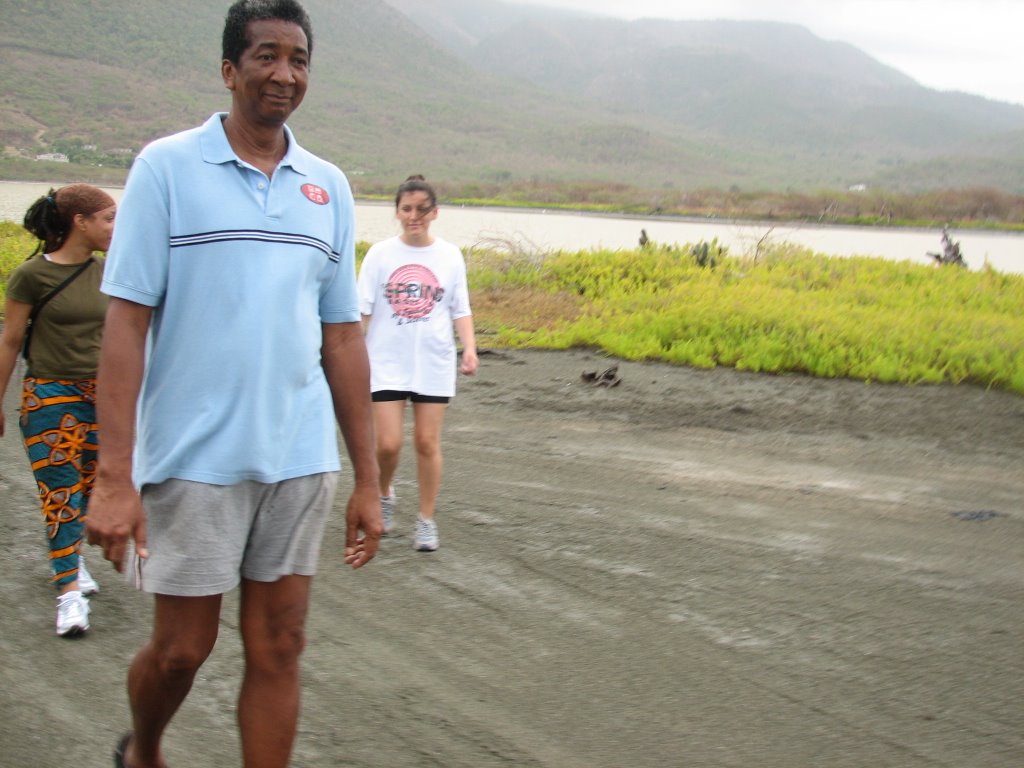
- Wake up early and go for a walk out along the salt pond and back along the beach with Kingsley Keith (foreground), Anne, Jillian, Hazel.
- Cheraine and Mike accompany Anne and Casey to Yallahs Basic School.
- Mike gets in trouble for wandering away to take pictures at the regional school event at the Baptist Church across the street.
- Visit to Yallahs Branch of Public Library. Taxis into Morant Bay. Juicy Patties and Sim Cards for Anne and Mike’s phones.
- Was Mike too mean towards the taxi drivers? We are each able to ride back for 50 J. Depending on who you ask, the tyical fare for a route tax bus is 60 or 70 Jamaican Dollars
- Matthew and Jillian travel to Seaforth with representative from RADA.
- Ciarra, Hazel and Christianne spend the day teaching at the Women’s Center.
- IMG_1042 to MVI_1199

Thursday, May 18, 2006 - Second day at the service sites.
- Anne and Casey to Yallahs Basic School, where they have a planning discussion with Mrs. Grant. Route taxi van driver is mean to them.
- Jillian, Matthew and Cheraine are dropped at RADA; their supervisor left for the field at 9:00 am, so they hitch a taxi home.
- Women’s Center group, Hazel, Christianne and Ciarra, find themselves teaching again.
- Evening walk, Mike shoots his first videos. Mike gets in trouble for separating from the group off the beach-walkers, prefering to take the back route along the road, where he shoots more videos
- Students lead discussion of the first book: Anne Kopena on the report from the World Bank.

Friday, May 19, 2006 - Rain Day.
- This wound up being a lazy day. We were to take an excursion, but Mr. Garnet doesn’t arrive until 4:00 pm.
- Students entertain themselves pretty much all afternoon at Carleva Bay.
- No pictures.

Saturday, May 20, 2006 - Kingston Day.
- Since Mike doesn’t have a map, we meet up with Kingsley Keith, Nelson's brother who lives in Kingston. He guides us past Tuff Gong down to the Industrial Zone and finally the Craft Market. - Several hours spent at the National Gallery of Jamaica. Shown is a right-hand panel of the work by artist Christopher Clave called 'Blackboard #20.' Once you get a look at the entire work, you will realize that it depicts the souls of black people swimming like a school of fish - a metaphorical treatment of the middle passage.
- Fiasco of trying to find a vegetarian restaurant in Kingston as everyone is hungry from missing lunch. Eve Restaurant is closed because the owners are Seventh Day Adventists.

Sunday, May 21, 2006 - Recreation Day.
- Christianne and Casey leave at 7:00 am to accompany Jay on a trip with his middle school students to an all-inclusive resort on the way to Montego Bay.
- The other group travels with Garnet to Portland. First destination is Reach Falls, officially closed but then reopened by the guide (who has to be paid to bribe security to the looking the other way). Nelson demonstrates masterful skills of negotiation, resorting to the patois and gets the group in for 800 J.
- At the falls, Mike walks downstream while Anne and Cheraine walk upstream.
- Another group of Americans arrive. How much per head – 200 J?
- On the way out the group purchases woodwork and blow toys.
- We continue along the coast to Long Bay, which is also very relaxing.
- In the end, everyone reports having a good day.

Monday, May 22, 2006 - Site Day.
- 6:00 am walk down the beach with other students: Nelson, Anne, Jillian, etc. Watching the fishermen pulling the nets.
- The Morant Bay volunteers leave earlier this morning so that Matthew, Ciarra and Jillian can hook up with their supervisor for the day. They end up having a full day in the field.
- Christianne, Hazel and Casey have what they describe as a slow morning at the Women’s Centre. At noon they lave with some of the girls and get an interesting tour of Morant Bay. Ciarra buys a lot of food!
- Anne and Casey stay at Carleva Bay for the day since their basic school isn’t holding classes Monday. They wind up spending a good portion of the day playing with Renaldo, a young man who lives next door with his father, and Hyacinth’s daughter.
- Mike talks with Carol Marfisi by phone and tries to get office work done; writes letter of recommendation for Penny Richards; corresponds with folks at church.
- Evening walk along the salt pond with Hazel and Anne; exercises and painted sky.

Tuesday, May 23, 2006 - Jamaican Labor Day.
- Mike wakes at 4:00 am, to find other students already awake in their rooms.
- Rainstorm at 5:00 am.
- Labor Day in Jamaica is like Phila's Martin Luther King Day of Service.
- Two students volunteer at Jay Grant's church, where members of the community are painting and picking up trash.
- Mike spent time posting stories and photos to the Flickr site and Edu-Tourism blog.
- Novella and Mike discussed standards for student assessment. We will be collecting and commenting on student journals this week.
- This evening student presentations continue, with Hazel Carrera helping us to get to know Nancy Lopez's book Hopeful Girls, Troubled Boys (Routledge, 2003).
- Mike is charged with the task of writing a sample critical reflection paper, that can be used as a model for students as they begin to consider the topic for theirs.

Wednesday, May 17, 2006

Edu-Tourism in Jamaica - Report #1

I have been traveling to the Parish of St. Thomas in Jamaica for the past three summers along with Nelson and Novella Keith, President and Secretary of Edu-Tourism, Inc. We provide university students with the opportunity to get involved in on-going service projects in this region. The NGO establishes partnerships with local organizations, trying to find interesting opportunities for students and ways that we might be able to help these organizations meet their goals. See coverage in the Temple Times for an overview.

On-going partnerships include the following
  • an initiative to place PCs in all of the basic schools of the parish, and to train the teachers at the basic schools so that the computers will be integrated into the curriculum. In this project we are supporting goals that have been articulated within the Ministry of Education in Kingston.
  • a partnership with the Women's Centre of Jamaica to improve the physical structure and expand the programming at the St. Thomas branch.
  • internships for our students with the St. Thomas offices of RADA (Rural Agricultural Development Authority) and 3D Projects (Dedicated to the Development of People with Disabilities).
  • an initiative to promote the creation of bio-latrines and the education of the general population in the benefits of their use.

Students traveling this summer and next Spring 2007 will make significant advances on all of these projects. Eight Temple University students arrived in Kingston on Monday, May 15, and have already begun their service work. They will be doing research on schooling and development issues in the Caribbean region. Each will be keeping a journal of their experiences over the course of the trip, with a particular focus on the work that they are engaged in at their service sites. They will be sharing insights, comparing experiences, and linking their experiences to the theoretical perspectives that they find in their course textbooks. All of this said, this blog should not be understood as an 'official mouthpeice of Edu-Tourism, Inc. Instead, this is written through the eyes and experiences of one person, Mike Dorn, a Temple University professor of education with interests in geography and disability studies.

I will be sharing my thoughts and answering your questions over the next four weeks as I accompany these students on their internship experiences and travel to some of the more remote sections of the island. Please check this space regularly for the latest reports from the field, and consider communicating with us. Drop your comments by following the link to the lower left. I will answer them the next time I find myself in front of my computer. Thanks, Mike

Monday, May 01, 2006

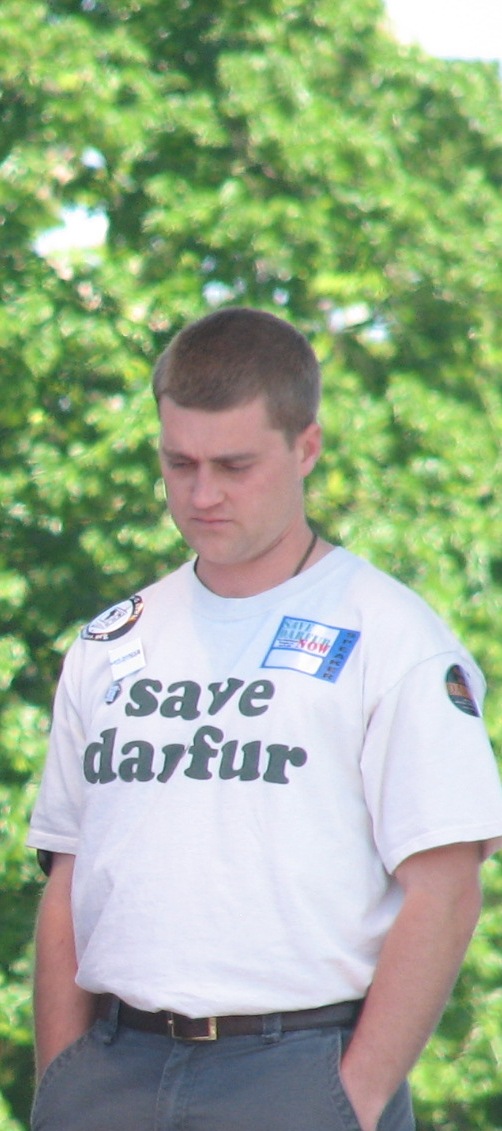
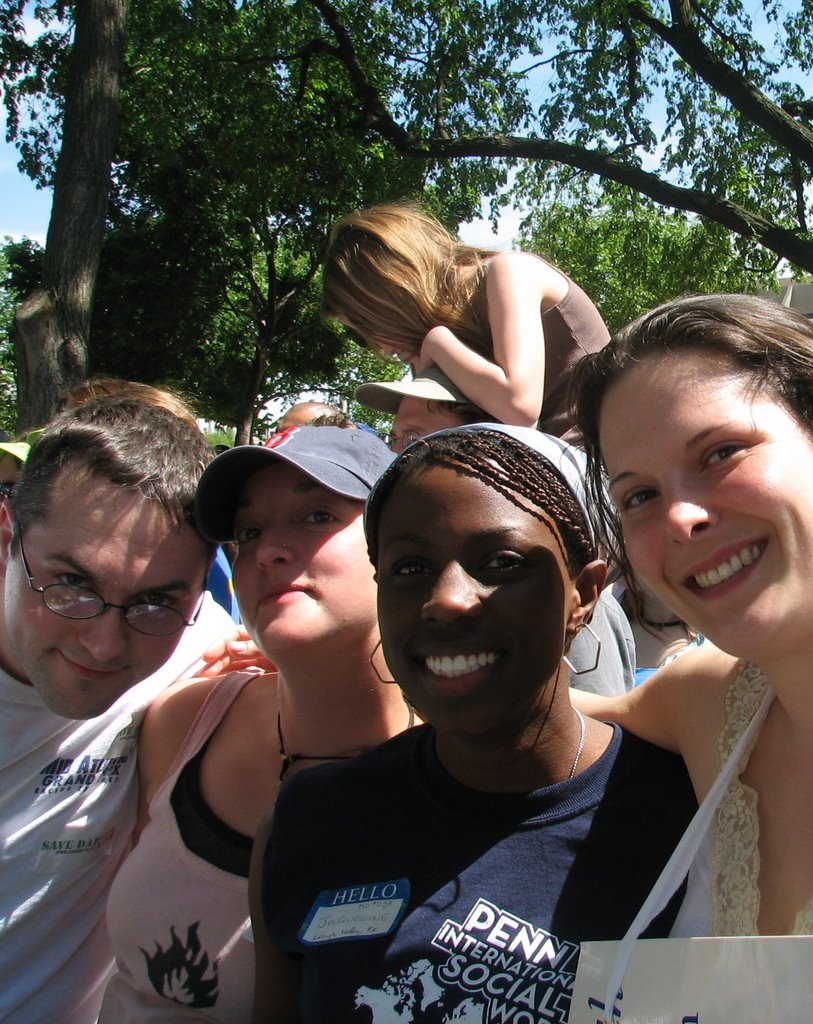
Save Darfur: A rally against genocide

On Saturday morning, I loaded a 60-seat bus along with six other members of the First Unitarian Church of Philadelphia and headed south on I-95. We were traveling to Washington, DC to participate in a small but very important rally with the goal of bringing to an end the genocide currently being perpetrated against the black Muslim population in the Sudanese region of Darfur. On the way down to DC we viewed a video called 'A Million Voices for Darfur' and enjoyed an excellent lecture by Hans Wuerth, professor emeritus of German at Moravian College, Bethlehem, Pennsylvania. Dr. Wuerth first put Sudan into perspective. It is the largest country in Africa by area, 1/4 the size of the United States. Laid across the US Map, Sudan would stretch along the entire East Coast from Maine to Florida. The Darfur region is 1/5 of Sudan, equivalent to the size of France!

This region in Sudan is where the Arab Muslim world meets the Black Muslim world, and has experienced a long conflict between the nomadic pastoralists and the farmers of the Sahel. As more exploitative land use patterns have developed in this region, these two world have collided. The story brings to mind the conflict between farmers and ranchers in the American Great Plains, only in this case the national government has clearly taken one group's side: the ranchers. Young unemployed men were trained and armed to advance government aims in the region. This is the infamous Janjaweed, destroying the villages and sytematically raping the women of the region. Their actions where brought to the world's attention by Brian Steidle, a former Marine captain and observer to the African Union peacekeeping forces. His photographs show refugee camps being attacked by punks in helicopter gunships and a despairing population left in their wake.

The Save Darfur Coalition has derived much of its energy from an effective mobilization on college campuses, and the protest was remarkable for the the range of the participants' ages. Families with their children, high school and college students as well as elderly persons - each affirming that they would never let genocide happen again without protest. "Never Again!" or as Pres. Bush scrawled on the margins of a report on the Rwandan genoide, "Not on my watch!" As the Washington Post writer indicated, this was a protest that drew from across the political spectrum, African American leaders, Muslim and Jewish leaders as well as distinguished African speakers. Taking the lead in this effort have been two groups that know all too well the ways of means of genocide: The American Jewish and Armenian populations. I was particularly proud to see the President of the Unitarian Universalist Association, Rev. William Sinkford, leading off with an ecumenical and apt prayer. Some of the 'stars' that spoke at the rally include Eli Wiesel, Rev. Al Sharpton, Barak Obama, and Nick and George Clooney.

I was blessed to be attending the rally with an energetic group of young UU activists. We have been talking about way to leverage the latent energy within our congregation to make a difference in our communities. Like the Sudan, Philadelphia has its own racial and class divides that we must be ever vigilant to overcome. Getting older and younger UUs on the same page is an important goal of our transition to a new settled minister at the First Unitarian Church. Now that we have active Young Adults and 35PLUUS groups, how do we set up mechanisms to coordinate joing activities? This trip to Washington was a sign of tangible collaboration, and I hope to witness more of it incoming months.

Since returning to Philadelphia, I have been speaking individually with my colleagues here that the Institute on Disabilities and they have been remarkably eager to make their feelings known. In Washington it was announced that so far 760,000 postcards have been delivered to George W. Bush. I'll be sending 10 more tomorrow. Let me share just one of these messages.

Mike

__________________________________

Dear President Bush,
Please express your humanity by doing everything that our country is able to do to stop the atrocities.
Sincerely yours, Carol Marfisi

Sunday, April 30, 2006

Edu-Tourism's revitalization

Edu-tourism has always been a side project of Mike Dorn, professor of Urban Education and Disability Studies at Temple University. Efforts to get other students and faculty involved in as co-editors have been largely unsuccessful. Instead of wishing things otherwise, I will proceed with a more appropriately personal approach to posts in this log. The next year will be full of change and transformation, and I invite you to share these experiences with me, as I will be spending more time in Jamaica with my students and in Michigan with my wife. Edu-Tourism will feature more photographs that up until now have been languishing in my Flickr photostream. Perhaps even some members of my family will stumble across these posts. I'm still waiting for the 'blog revolution' to take hold in Hilliard and Worthington, Ohio. I hope you enjoy the reorientation and I look forward to hearing from you.

Saturday, December 24, 2005

Edu-Tourism 2006 Information session

To all Temple students and Philadelphians who love Jamaica and want to make a difference ... Get involved in a new student group that will be fundraising and traveling together to Kingston and the eastern parish of St. Thomas, Jamaica this coming late May to mid-June, 2006. We will work hard, do good and have fun. Enroll and earn six Temple University credits.

The time to start preparing for the trip is now! Our next information will be held on Monday, February 13 in the centrally-located seminar room 301 GLADFELTER HALL (6:00 to 7:00 pm information session; 7:00 to 8:00 pm fundraising and planning meeting). Food and drink will be provided.

As you prepare for this meeting, pertinent information can be found at our Temple University Edu-Tourism website.
And keep up to date on planning of the summer trip by joining The Edu-Tourism Jamaica Meetup Group, – contact Mike Dorn for more information.
Thanks as always for your interest and support. MD

Sunday, November 20, 2005

gosiame (goodbye) to Gabs

November 20, 2005
Dear Friends & Family:

My time in Botswana is coming to a close soon. The past 2 weeks have been busy, with busy weeks in the hospital and weekends exploring the wildlife and landscapes of Botswana and nearby.

Work at the hospital continues to be intense, with many sick patients, deaths of some of our patients (many younger than us—young doctors in our 20s and 30s hate to see patients die younger than us—but then doesn’t everyone?), but also with some nice saves. One woman I had feared would just get worse sat up on Tuesday and said, “I’m going home.” Only then did I appreciate how much better she was—from “death’s door” as it were—and we sent her home the next day. The wards demonstrate a phenomenon gone from American hospitals with their single and double rooms—patients helping each other. We had a 13 year old girl for 2 weeks, and she and the older women around her formed very sweet relationships, helping to get water, and just encouraging each others’ recovery.

I have been amusing my patients with Setswana, a little more each week. While a very kind young Motswana tutored me before my departure, I have struggled with how much to try to communicate in Setswana (the first language of most of my patients), or English (the official language of the country, which is familiar to most Batswana under 30, but quite variable in those who are older because schools were not universally available before the 1970s). I can say hello (dumela), please (ke kopa gore), thank you (ke a leboga), and basic greetings, and I have some medical vocabulary (madi for blood, mathata for problem, botlhoko for pain), but with only a few lessons and perhaps 20 hours to study, once I ask the question, what will I do with the answer? I think the main purpose of my attempts at Setswana is to express my respect for Botswana’s people and culture, and to offer an opening for them to share the ultimately personal and frightening symptoms that have brought them to medical care.

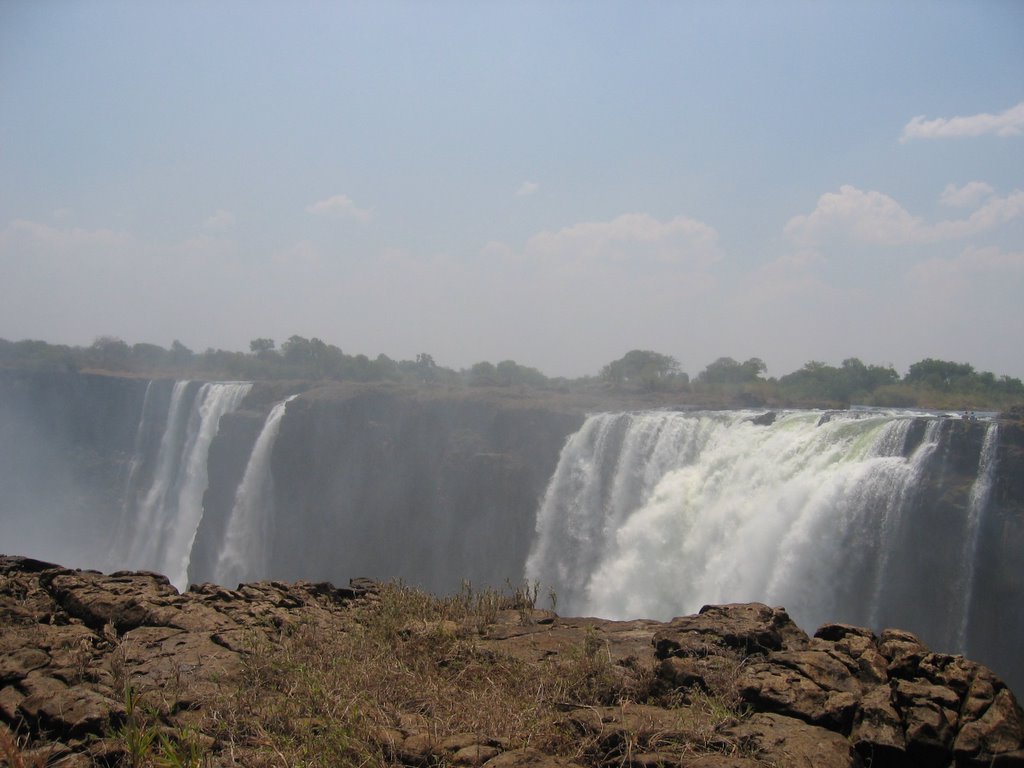
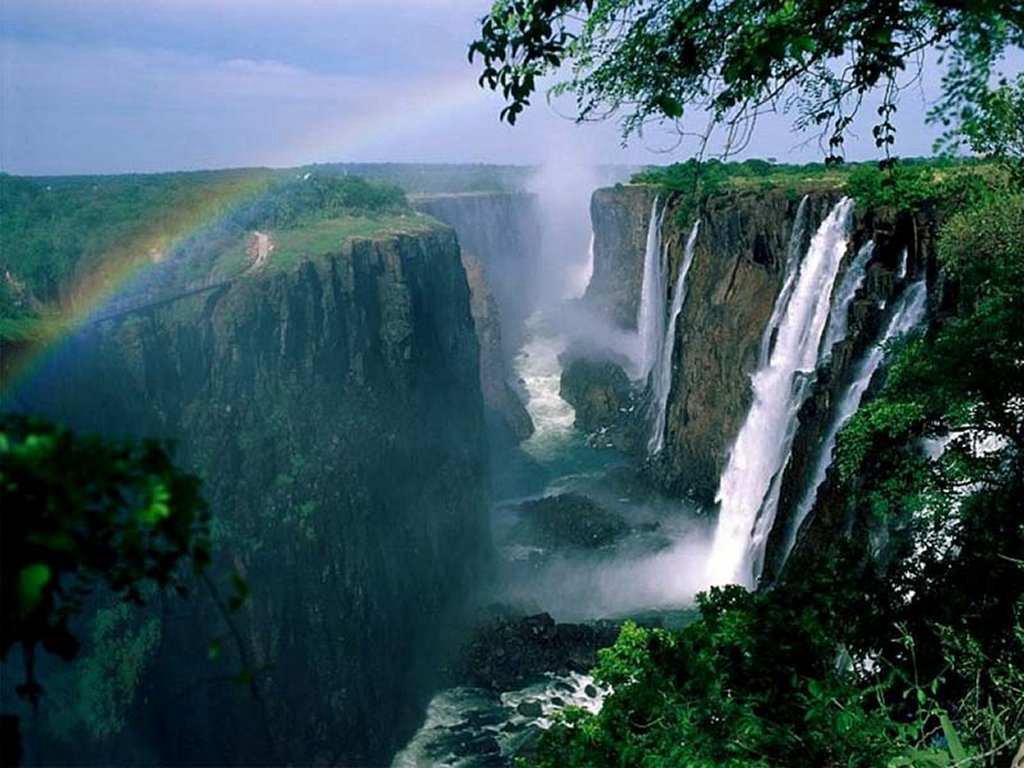
Last weekend I went with one of the others to Chobe National Park and Victoria Falls at the border of Zambia and Zimbabwe. Vic Falls is beautiful, but sad to see. The mighty Zambezie river which rushes over the rocks in Zambia to land in the gorge below is very dry, with a few small falls where a massive 1.7 km wall of water is meant to be. It is beautiful nonetheless, but one feels for the people and animals dependent on all that missing water.


The Chobe river in northern Botswana serves massive herds of elephants, hippos, antelope, and buffalo, and we got to see them in their natural glory.

This weekend I went to the edge of the Okavango Delta, where three of us stayed with a lovely Zimbabwean family who have worked in tourism all over Africa. They were extraordinary guides, and shared with us their local contingents of hippos, elephants, zebras, lions, giraffes, and a leopard with her little cub. Just breathtaking—you’ll have to see the pictures.

In a few days I return home. I have learned so many of the timeless lessons we all learn from travel. What is special about home, what is peculiar about home, and a tiny little bit about what it might be like to live another’s life…more on all this later.

Peace,
Carla

Wednesday, November 09, 2005

Touring Southern Africa


This weekend Carla will be traveling north to visit the famed Chobe Wildlife Reserve. A region rich in the famed flora and fauna of Africa. We all look forward to her report upon her return!

One of the greatest natural wonders in Africa, the Falls of the Zambezi River, 5,400 feet wide, 320 feet deep. Named Victoria Falls after the English queen, by the explorer David Livingstone. The falls are not nearly this wet currently, as a result of 4 years of drought in the region. This stretch of the Zambezi River flows between the countries of Zambia and Zimbabwe.

Sunday, November 06, 2005

With another week gone, and a little more seasoned, medicine in Botswana is both more familiar and more extraordinary

November 6, 2005
Dear Friends and Family:

With another week gone, and a little more seasoned, medicine in Botswana is both more familiar and more extraordinary. The average age of my patients is mid-30s, with a few middle aged diabetics and elderly heart patients, and many young people admitted with HIV, meningitis, wasting syndrome, and coughs suspicious for TB, and often all of these. It’s not uncommon that I look at a patient, and only after looking at the chart do I appreciate how disease has aged them 10 or 20 years.

On the one hand, we don’t have all the tests we are used to back home (notably the CT scanner is broken and there are no MRIs; and the young patient we have with a bleed in her brain has to go to South Africa for further investigation since there is no place in the country to get an angiogram). On the other hand, we are finding we don’t need all of these tools for everyday diagnosis and treatment. Blood tests, ultrasounds, and other procedures we might otherwise do at home are passed in favor of empiric treatment for the most likely condition. Some of those tests really are redundant, and others simply confirm a suspicion. Sometimes we use them to decide between a number of different possibilities, but as often we are relatively certain before ordering the test.

One friend, John, before he left said that working here has made him more impressed with the amazing possibilities of trauma surgery, intensive care medicine, and the "good saves" of people with serious injuries and illnesses who we can return to normal lives. John also said his time here has also highlighted the ways that in the U.S. we sometimes lavish painful and expensive treatments on people who are obviously dying, and miss the opportunity to help patients and families come to terms with their deaths. I couldn’t agree more with both of John’s observations.

This practical approach to resource allocation is born of scarcity, but the fact that I can use my time and the hospital’s money doing what is possible instead of chasing rescue fantasies is reassuring. Our new medical student has observed that we don’t call "codes", as we do in the United States. Any patient not on hospice found pulseless in an American hospital will be subjected to a ritual of epinephrine, electric shocks, and chest compressions.

This is rarely helpful. In fact, outside of trauma situations in which a young person is bleeding and cardiac events in which a heart attack leads to a "shockable rhythm", patients who lose their pulse are usually quickly pronounced dead, subjected to another few days to weeks of intensive care only later to succumb, or are maintained in a "persistent vegetative state." This is not to say that we should not "do everything" for people with severe disabilities, but sometimes we prolong suffering without hope of improvement instead of prolonging meaningful life. Unlike at home, those with end-stage diseases are allowed to pass quietly.

There are frustrations: medications that would be useful, or even life-saving, which we are supposed to have, are mysteriously not in stock. Last week the laboratory computer system was down for 2 days, and lab results that take 1-2 hours at home, which can sometimes be had the same day at Marina, were held up in the queue. Supplies appear to back up at every level, with materials available from vendors, but not purchased; materials in the Ministry of Health’s central supplies, but not available at the flagship hospital, and items such as hand soap plentiful in the hospital stores but unavailable on the male medical ward…

On the weekend, we went away as we so often do, this time to the Khama Rhino Sanctuary in the center of the country, where we saw a few of Botswana’s remaining Rhinos (largely hunted to extinction for trophies and Chinese medicines), antelope of various kinds, wildebeests, hartebeests, zebras, and the "wild" painted dogs who are endangered.

Next week on to Victoria Falls and the Chobe Wildlife Reserve, where the largest groups of elephants and hippos in Botswana are to be found.
Peace,
Carla

Sunday, October 30, 2005

It has been 10 days since I arrived in Africa

Dear Friends: It has been 10 days since I arrived in Africa. I left Philadelphia at 5:40 am for Atlanta, and waited 3 hours there for the next flight. The flight from Atlanta to Johannesburg, South Africa is the longest I have ever been on, 18 hours including an hour refueling in the Canary Islands. Then after another 3 hours in Johannesburg, it was an hour on a prop plane to Sir Seretse Khama International Airport in Gabarone, an unimposing one-story brick building with one gate.

I was picked up from the airport by Gill, a white Motswana (singular for Batswana, the name for the people of Botswana) who has lived most of her life here, with brief stays in the UK for training in her youth. She and one of the other residents brought me to the ICC flats, a gated community where Penn has rented two apartments for the rotating physicians and medical students who come to work at Princess Marina Hospital. The flats are largely expatriates, and when I asked about identification, I was told that the guards would know I lived there because I was white. "There aren't many of us here," explained the other doctor.

Marina is the largest hospital in the country, serving as a referral hospital for specialized services, and for opinions from specialists not available at the regional and local facilities. Nyangabgwe Hospital in Francistown (about 8 hours by car to the north) serves as the referral hospital for the northern part of the country. Many special services, including CT scans, and consultants such as oncologists, are only available at Marina or Nyangabgwe, and some such as neurosurgery, are only available at one of them. If patients need cardiac surgery (such as valve replacement for rheumatic heart disease), angiography, or other high-technology procedures, and they are citizens of Botswana, they are sent to private hospitals in neighboring South Africa and the government pays the bills. In practice, some referrals to Marina are for end-stage patients for 'further management,' and in my experience these patients are already dying on arrival, or for services such as blood transfusion or oxygen therapy, which are supposed to be available at all hospitals, but are often not because of short supplies. (In fact, last week Marina ran out of B-type blood for 2 days, and the previous week ran out of oxygen.)

All nurses are Batswana, but all doctors are foreigners or foreign-trained. Botswana has just opened its first medical school and now has students in the third year. For 40 years since independence in 1966, they have sent their bright young people to the US, the UK, the Netherlands, South Africa and elsewhere for medical education, but many do not return because of better conditions and higher pay where they train. Of the 500 would-be doctors sent abroad in the past 30 years or so, only about 100 have returned. And since only citizens can hold jobs in the Ministry of Health, many of the Motswana doctors are there, with others in private practice. Since patients are most likely to speak English if they are under 30, we often need translation from Setswana, either from a nurse or a Motswana doctor (in the male ward where they often have neither, it is sometimes the patient in the next bed). I have been taking lessons, and have only a minimal knowledge - I can ask if they are better, if it hurts here (pointing), and would they breathe deeply. More complex questions require translation, no so much because I can't ask the questions, but because I can't understand the answers. I quickly realized that when talking to a family who speaks only Setswana about a death, my job is simply to look sorry and ask the nurse if they have any questions. Delivering the news becomes her task, as my Setswana is simply not up to such a delicate task.

Princess Marina reminds me of many places I have seen or read about. First, it is a massive complex in the center of the capital, perhaps 20 buildings, perhaps more. The heart of the hospital complex is built on the pavilion style made so popular in the late nineteenth and early twentieth centuries by the work of Florence Nightengale. The separate single story ward buildings with open walkways between, which allow for maximum ventilation without any mechanical systems, which many of my colleagues assume to be eithepeculiaritycuiliarity or a colonial hold-over was actually the highest technology in tuberculosis prevention a century ago, and surely still serves this function at Marina, where conservatively a third to half of admissions to medicine have 'rule out TB' as at least one of their problems. We are very crowded in the medicine wards at Marina, with a female ward designed for 30 patients in five bays with 6 beds each bay frequently housing 10 patients on beds, 2 on mattresses on the floor, and one around the corner in the hallway. On Tuesday when my team was admitting, they just kept pushing the stretchers in despite the fact that there was no place for them to go. I think we must have peaked at about 75, and one could barely walk out of the ward around the traffic jam of sick patients.

Marina also reminds me of the nineteenth century hospitals of Paris and other major cities, including those in the US. But as a grand complex with open wards, and very sick and often dying patients, it is more like the charitable facilities that were run in the nineteenth century, where patients went only if they had nowhere else to go, and in which they expected care but cure was usually beyond them. Eighty-five percent of the patients admitted to Marina are HIV positive, with many admitted to medicine for end stage HIV/AIDS, cryptococcal meningitis, tuberculosis of the lungs, joints, and many other parts of the body. The population as a whole is more like 40 percent HIV positive, with a skew toward the young and working-age population (about 55-60% between 18 and 49). These are the highest documented rates in the world, but interested observers believe that the rate is actually similar in neighboring South Africa, Zimbabwae, and other nations, and that Zimbabwae is too chaotic to survey, and South Africa too deep in denial. "This virus is tearing us apart," said one of the administrators at Marina to me. The President and the country's leadership realize that they have to fight HIV.

At the same time, Marina sometimes has late twentieth century technology, including ultrasound, echocardiography, a CT scanner, lab testing, and medicines from penicillin to streptokinase (a clot-buster used to stop heart attacks in progress. Then again, there is no ciprofloxacin in the country, and my first week we ran out of most of the different kinds of IV fluids. The tuberculosis patients cough on each other, and on the staff (the nurses wear surgical masks, but apparently no one has told them they are useless for TB - the thicker kind that would offer some protection would be stifling in the un-air conditioned wards and 90+ degree heat).

There are some peculiarities to the use of invasive medical technologies in these conditions. I have long wondered whether hospitals that re-use needles are doing more harm or more good compared to nothing, traditional medicine, or simply refusing to use technologies that cannot be safely administered (then again, I wonder myself about use in any setting of dangerous drugs, especially many chemotherapies, transfusing blood products which could always be tainted, and many of the surgeries or CT scans we do routinely at home with risks of death, organ failure, infection, etc.).

But these academic doubts come to little when I look in the sunken eyes of a woman dying of overwhelming infection, and I will place an IV, administer drugs and oxygen, and tell her family that we are doing what we can. I had such a lady last week, and when I talked with her relatives, her brother said that he wondered if there could be more done with more resources. I looked him in the eye and said that I come from America, and with all of our machines, and medicines, there was nothing we would have done for her there that was not being done. I think that was a comfort - I hope so. I cannot always say that, but when asked, if it is true, I am glad to do so. She died that night.

I saw another patient that day, a lady whose liver had been replaced by cancer, and who was therefore in complete liver failure. When she got worse, I considered giving her a blood transfusion or a transfusion of blood plasma (to replace the clotting factors her body could no longer make). I knew this lady was going to die no matter what we did, and thought perhaps we could delay this by a few days, but no more. At home, we would have tried unless her family declined the care. Here I hesitated. As I told the Motswana physician with whom I work, I would have felt terribly guilty if someone came in later that day after a motor car accident, and died of bleeding because I had used that FFP on a lady who was going to die anyway. He agreed, and we did not give the plasma. She died about 15 minutes later.

While these resources are limited at home as well, they are not so constrained as to offer such direct consequences - usually at home it is about money, and neither patients nor physicians consider that a major factor in treatment decisions at the time of lifesaving treatments. I know we should sometimes be more realistic, and often push both families and the senior physicians to accept the inevitable, but it's a fine balance between accepting what you cannot change and giving up too early on someone who might make it (then again, these issues usually arise at home in patients who have cancer and are known to be terminal, and the argument is about how soon ...

Finally, the level of sickness, the frail, thin, wasted patients remind me of both so many famine relief campaigns and of the early AIDS epidemic in New York. In the mid-1980s, up to 30-50 percent of admissions to medicine beds at hospitals (distinct from surgery, OB/Gyn, and pediatrics beds) were for HIV related conditions. Here it is more. And the people who come in with TB and late-stage HIV can have sunken eyes, flat or sunken bellies, and arms as thin as 2 inches in diameter - if that. Some will recover, many will not. But Dr. Gluckman, one of our senior physicians, says no one should die without at least trying drugs for TB (and HIV if reasonable). After starting an ambitious national HIV treatment plan 2 years ago with assistance from the Gates Foundation and Merck, Princess Marina Hospital has the largest HIV clinic in the world in terms of people under outpatient HIV treatment. They have a multi-million dollar pediatric HIV project in partnership with Baylor University, and a major AIDS research complex associated with Harvard. On the one hand, we are all trying to help, but then again I feel a bit like a voyeur watching a train wreck (an image of vultures also comes to mind) but if I were not here, who would see that Sylvia got her amphotericin every day ...

All this is against a background of a dry but beautiful country, a small provincial capital city, friendly people (though as a white person in a majority black country, sometimes I feel like I am the animal they are looking at on Safari). Last weekend I took some time to recover from the jet lag. This week I ventured to the Main Mall downtown, which with its hand-painted signs, chaotic traffic and layout, street vendors, and yet high-tech services such as cell phones reminded me most of all of small and medium-sized cities in Mexico.

This weekend I, two other residents, and a medical student went to the Kalahari (Kgalgadi in Setswana (the English spelled it wrong again) to see wildlife and scenery. It was hot but not as bad as Gabs had been last week. We saw giraffes, antelope of various kinds (Gemsbok and Springbok in Setswana), vultures and other birds, and a few badgers. While lions have been seen in the Kgalgadi, this is the third year of drought, and there have been many areas burned either spontaneously or as fire breaks, so many of the animals have departed for better grazing elsewhere. Finally, we took a walk with a member of the San, who showed us how to make fire with two sticks, a small stone, and some dry grass, explained how they used the snakes, spiders, and worms to poison their arrow tips, and how they get water from the tubers in the ground.

Now back in Gabs for another week at Marina. I think on balance that the patients I see each day are better off that we are there, though the locals are working hard to teach us about the diseases they see most often, and how to treat many things without all the expensive tests we are used to.

More soon.

All my love,

Carla

p.s. Elise, it was in the 90s Farenheidt all week last week, and in the 80s this week, and no the Penn flats don't have AC. The hospital doesn't have AC, but also doesn't have chairs, more than 1 computer per ward, etc.

Sunday, October 23, 2005

first days in Botswana

Dear Mike: Gabarone reminds me of Leon, Mexico and other third-world cities I have seen. The expat cocoon here is quite dense: living in a gated community, restaurants that are predominantly white and foreign clientele, and a language barrier that is profound (despite an official language of English) between us and the elderly and poor because of availability of schooling in the past and present school fees.

The hospital is as expected, and reminds me quite a bit of what I have read about nineteenth- and early-twentieth century wards (11 patients to a cubicle, with the extra mattresses on the floor) and pavilion architecture (which I explained to a colleague yesterday was not about inefficiency but about TB prevention). The suffering of the people is certainly great, and borne with a dignity (resignation?) that is at once admirable and sad. I think I can be useful here, and have much to learn (and teach my colleagues gently).

The country is very warm and dry, as expected. The plant life are all desert species. We spent the weekend swimming, hiking, and at a fascinating party. The Motswana man who tried to pick up me and the medical student I was with (I had heard about this feature of African men...) acted physically wounded when he saw my wedding ring, and wanted to know why my husband let me come to Africa without him ...

But the Ugandans and Batswana I have met are also eager to dispel the myths they see in the international news, that "we are not animals." Carla

Thursday, October 20, 2005

safe in Botswana

Dear Friends: I have arrived safely in Gabarone, Botswana after a
cumulative 21 hours in the air and 6 hours at various airports. It is warm
and inviting here, and will be even more so after I have had a nap.

More soon ... Love, Carla

Tuesday, October 18, 2005

Heading to Botswana

Hi! I'm Carla Keirns, Mike Dorn's wife.
Tomorrow I leave for Gabarone, Botswana, where I will spend the next 5 weeks working in a hospital there.
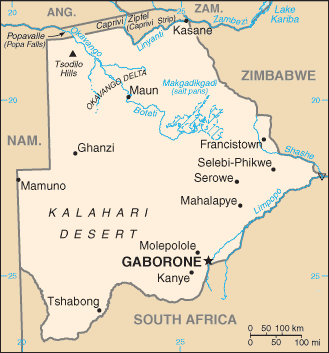
For those who don't know it, Botswana is a country of about 2 million people in Southern Africa just north of South Africa and west of Zimbabwae. Its other bordering nations are Namibia and Gambia. The country of Botswana is predominantly Kalahari desert in the west, so most of the people live along the eastern edge of the country where there is enough water to live and raise cattle. Besides beef, the main export of Botswana is diamonds.
I'll send occasional posts about my activities there, and about things the larger world should know.

Carla