Carla and I were lucky enough to be invited to present on work in progress to a supportive audience at the University of the West Indies, Mona Campus. The closing performance by Sharon-ann Gopaul McNicol was fitting the the setting, the Old Dramatic Theatre. Dr. Gopaul-McNicol spoke about the need for psychologists to consider the field of politics as an arena of activity, and the still too evident challenges of addressing the colonial mindset far after the political independence of Caribbean states. In all, a thoroughly enjoyable presentation with its mixture of exhortation and evangelism. We all left with a renewed sense of purpose.
Sunday, March 15, 2009


Saturday, December 27, 2008
Travelogue

Saturday, July 05, 2008
Saying Goodbye
Well, all good things must come to an end. This photo documents the last minutes at Carleva Bay for this year's group of Temple University students. 12 in all, they had a great time exploring and working with our partners on projects of their own design. Many of these projects will be continued on future trips.


The great thing about photoexpeditions is that you not only get to look at your own photos years later, but you also get to share multiple interpretations of the same site. So it was the the Morant Point Lighthouse Trip - such an evident success that we are definely going to have to plan a followup for the return trip to Jamaica. After viewing my photographs (many taken on rainy days), several members of the Kingston, Jamaica Flickr Meetup Group have expressed their desire to hike the Cunha Cunha and/or Corn Puss Gap trails. As far as I know, the Cunha Cunha Trail is the only one open to the public, and this is only due to the carefuly management of the Bowden Pen Farmers, on behalf of eco-tourists, the national park and their fellow community residents. Corn Puss Gap, renowned amongst birders, would need a similar investment of effort in order to be cleared. Perhaps we have put the hurricane years in our past, and we can work together to publicize and reopen this national treasure. MD
Friday, July 04, 2008
Photo featured with NPR story
Edu-Tourist strikes again! Readers of this blog will recognize that I have been enjoying the opportunity to teach two summer abroad courses in Jamaica for the past five weeks, organizing a field excursion with members of the Kingston Flickr Meetup (see below) and enjoying the hospitality of Ms. Beverley Smith of the St. Thomas Emancipation and Cultural Association, and Ms. Linette Wilks of the Bowden Pen Farmers Association (reviews forthcoming).
Meanwhile, other photos taken in Philadelphia have been getting the attention of the National Parks Conservation Association and National Public Radio. On July 1, NPR ran a story on the National Park System that featured a photograph, I took two years ago of the exterior of the Tadeusz Kosciuszko National Memorial, located at 2nd and Pine in the Society Hill neighborhood of Philadelphia. I thought it was a great capture at the time, and it is really fulfulling to find that others agree! The story of this national memorial is just fascinating to me, and was pleased to see how Robert Smith captured it in audio and text for NPR, even though the story apparently generated some critical listener feedback.

Meanwhile, other photos taken in Philadelphia have been getting the attention of the National Parks Conservation Association and National Public Radio. On July 1, NPR ran a story on the National Park System that featured a photograph, I took two years ago of the exterior of the Tadeusz Kosciuszko National Memorial, located at 2nd and Pine in the Society Hill neighborhood of Philadelphia. I thought it was a great capture at the time, and it is really fulfulling to find that others agree! The story of this national memorial is just fascinating to me, and was pleased to see how Robert Smith captured it in audio and text for NPR, even though the story apparently generated some critical listener feedback.
Saturday, June 21, 2008
Calm afternoon at Rocky Point, Jamaica
As our driver Mike Marshall reminded us, there are two Rocky Points, one on St. Thomas and the other in Clarendon. Rocky Point in St. Thomas is a sleepy fishing village that affords an opportunity the replentish and relax after a grueling drive on mud track out to the Morant Point Lighthouse. We found this visit to be very educational as well. Mrs. Beverly Smith of the St. Thomas Emancipation and Cultural Association (STEPA) is looking into developing grant funding to provide guided tours of the Great Morass. As luck would have it, my wife Carla and I were able to meet up with her and her husband during our short visit to Rocky Point. They had just returned from a trip with the fishermen in one of the motorboats up into the morass. The discovered that it eventually got so narrow that they would have to return with an even narrower boat. Sounds like an ambitious project, establishing tours of the Great Morass for the adventure tourist in all of us. Look for updates as we learn more about these plans


Wednesday, June 18, 2008
Bellevue Great House, S. Anne
I hope to be able to visit this coffee plantation on an upcoming trip to Jamaica.

Tuesday, June 17, 2008
Implications of the informal economy in Oracabessa, St Mary
Young men in Jamaica are raised with the expectation that they will leave school at a young age and hustle in order to support their families. Opportunities for support vary according to the region one lives in. When visiting the National Gallery of Jamaica, I ran across what appeared to be an informal car wash less than a block away. Driving around the city, one also frequently sees clusters of sidewalk venders roasting over charcoal in oil drums cut in half and raised on legs. As photoblogger Claude Fletcher notes, even the nation's forest reserves aren't safe from the growing demand for charcoal.

Monday, June 16, 2008
Sunrise over the salt pond
We have been bringing groups of students to St. Thomas for five years now. For the first two groups, accommodations were arranged at a hotel in Morant Bay. For the past four years, however, the students have enjoyed the opportunity to get to know the rural landscape around Yallahs. The villa purchased by Novella and Nelson Keith in 2005, now known as Carleva Bay, is located in a neighborhood known as Pondside because it is curls around the end of a large salt pond. Every summer I find it difficult to say goodbye to Jamaica and to return to the United States and mornings like these are part of the reason why.
Certainly there is important work to be done at Temple University promoting the Disability Studies and Urban Education Programs. But our work in Jamaica is also valuable and reenergizing. The history of the Midatlantic is linked in so many ways to the Caribbean, through trade and through self-definition. Jamaica retains historic ties to Africa that are merely rhetorical for many of our Philadelphia residents. I have enjoyed getting to know the diverse society supported by the island. But I also recognize that in order to gain an even broader appreciation for the story, I will also need to make a trip to Africa. Or Haiti?

Certainly there is important work to be done at Temple University promoting the Disability Studies and Urban Education Programs. But our work in Jamaica is also valuable and reenergizing. The history of the Midatlantic is linked in so many ways to the Caribbean, through trade and through self-definition. Jamaica retains historic ties to Africa that are merely rhetorical for many of our Philadelphia residents. I have enjoyed getting to know the diverse society supported by the island. But I also recognize that in order to gain an even broader appreciation for the story, I will also need to make a trip to Africa. Or Haiti?
Thursday, June 05, 2008
Returning to the Morant Point Lighthouse
The Jamaica Flickr Meetup Group is joining with Edu-Tourism, Inc. this week to sponsor an excursion to the Morant Point Lighthouse in St. Thomas. It will be a full day, starting at 7:00 am in Kingston, featuring a drive across a mud track to the easternmost point in Jamaica, and finishing up with hospitality at Carleva Bay. You can check out the photographs taken during the trip on this flickr discussion board.
Registration with the Jamaica Flickr Meetup Group may be required to view these photographs. What more incentive do you need to join us?

Registration with the Jamaica Flickr Meetup Group may be required to view these photographs. What more incentive do you need to join us?
Wednesday, May 21, 2008
PM Bruce Goldring on BBC's "HARDTalk"
If the Jamaica Gleaner are Jamaica Observer are fair indicators, Jamaicans are standing by their prime minister while awaiting the international backlash. What will come next? How can people with alternative sexual orientation possibly count on protection by rule of law after the homophobic sentiments expressed by Jamaica's new prime minister Bruce Goldring in his BBC interview with Stephen Sackur, aired Tuesday, May 20, 2008? How he can he bring the murder rate under control while tacitly condoning the discrimination of such a sizeable segment of the population? BBC has posted the Goldring interview on in three installments on Youtube, but this topic is treated in the third - check out the comments for common Jamaican sentiments.
Thursday, May 08, 2008
Blue Mountains Kumina


This video of a Kumina group was shot by faculty of the University of Indiana at Ambassabeth Cottages, high in the Blue Mountains.
To learn more about the history, geography and culture of this region, I recommend the following books. Start planning your own visit and learn from the farmers of Bowden Pen, St. Thomas.
To learn more about the history, geography and culture of this region, I recommend the following books. Start planning your own visit and learn from the farmers of Bowden Pen, St. Thomas.
- Bev Carey (1997) The Maroon Story: The authentic and original history of the Maroons in the history of Jamaica, 1490-1880 (Gordon Town: Agouti P, Maroon Publishing House).
- Kenneth M Bilby (2005) True-Born Maroons (University of Florida Press). Jamaica Gleaner review.
Sunday, August 19, 2007
Hurricane Dean news from Kingston
News from Kingston - Power Going Down
Sunday, August 19, 2007, 9:00 am
By fwade - moving back to ja
In an hour or so (10am Jamaica time) we are supposed to lose power -- an intentional shut down for safety reasons. There is also a 48 hour curfew that is in place. So you might not be hearing from this part of the world in a few minutes, for what could be a while. What we will have is decent cell phone coverage, however. So, here we are, sitting and watching and waiting for Dean...
Power 106 News - Dean tracking south
Sunday, August 19, 2007 at 1 pm
From go-jamaica : storm news
The Meteorological Services of Jamaica is reporting that Hurricane Dean is now located 90 miles south east of Morant Point. Duty Forecaster at the Met Office Viola Jones says the system remains a powerful category 4 system. Meanwhile meteorologists from the weather channel say the system could be very destructive.
Sunday, August 19, 2007, 9:00 am
By fwade - moving back to ja
In an hour or so (10am Jamaica time) we are supposed to lose power -- an intentional shut down for safety reasons. There is also a 48 hour curfew that is in place. So you might not be hearing from this part of the world in a few minutes, for what could be a while. What we will have is decent cell phone coverage, however. So, here we are, sitting and watching and waiting for Dean...
Power 106 News - Dean tracking south
Sunday, August 19, 2007 at 1 pm
From go-jamaica : storm news
The Meteorological Services of Jamaica is reporting that Hurricane Dean is now located 90 miles south east of Morant Point. Duty Forecaster at the Met Office Viola Jones says the system remains a powerful category 4 system. Meanwhile meteorologists from the weather channel say the system could be very destructive.
Thursday, July 05, 2007
Bloglines - Incremental infrastructure, or how mobile phones might wire Africa
Bloglines user mdorn (mdorn@temple.edu) has sent this item to you, with the following personal message:
Does the expansion of cell phone use in countries like Jamaica offer any insights into development strategies more generally? Power blogger Ethan Zuckerman shares his thoughts. Mike
| |||||
|
Saturday, June 16, 2007
how do you get there? Cunha Cunha Pass Trail
As you can see from the photographs I've posted on Flickr ( 'maroon country' photoset ), one of my favorite places to take photographs in Jamaica is a Blue Mountain cultural treasure: the Cunha Cunha Pass Trail (CCPT). The trail runs between Maroon communities of Hayfield in the Parish of St. Thomas and Millbank in Portland. Local historians have traced the origins of the CCPT back the indigenous Arawaks. The Maroons (fugitives from slavery that established their own independent society in the mountains) built an elaborate system of trails that took off east and west of the main trail. Some of these trails are still used by farmers and hunters today. If you stay up there for a few days, you get to check out many of the local dishes. Two years ago Linette Wilks, leader of the Bowden Pen Farmers Assocation, prepared me and my guide Shaggy a meal of wild boar.
Ms. Wilks has been involved in youth development activities in Kingston for many years, and spends her 'retirement' in Millbank (although there is nothing retiring about Linette!) If you are driving up the valley of the Rio Grande River from Port Antonia the eco-tourist cabins are a few miles past Millbank. I must warn you, however: that road from Port Antonio is notorious and brutal, particularly in the rainy season. David Kingsley has only driven it once, and will not drive it again. We hear various reports from others about its current condition.
If you wish to visit the Ambassabeth Cottages, send Ms. Wilks a call well in advance (876 395-5351; ask her for her email address as backup). She can arrange for a trail guide to meet you in Hayfield for the hike over. The guide books say that she can also arrange to pick you up in Port Antonio or Kingston. The farmers of Bowden Pen say the hike is five and a half miles, but it seems longer. If you are going to hike over, you might as well stay overnight, prepare for rain, and bring repellent with DEET. We left mosquito netting at Ambassabeth, so perhaps you will be able to us it! The accommodations are substantial (albeit rustic), the food is wonderful, and the mornings are exquisite - the best time to go out on hikes, before the rain sets in.
While I was taking the trail photos and meeting my wife in Hayfield on Sunday morning, the six Temple University study abroad students were visiting the Quaco River with an expert guide. I'm hoping they will share their digital photos, and that I can share one or two of them here.
Ms. Wilks has been involved in youth development activities in Kingston for many years, and spends her 'retirement' in Millbank (although there is nothing retiring about Linette!) If you are driving up the valley of the Rio Grande River from Port Antonia the eco-tourist cabins are a few miles past Millbank. I must warn you, however: that road from Port Antonio is notorious and brutal, particularly in the rainy season. David Kingsley has only driven it once, and will not drive it again. We hear various reports from others about its current condition.
If you wish to visit the Ambassabeth Cottages, send Ms. Wilks a call well in advance (876 395-5351; ask her for her email address as backup). She can arrange for a trail guide to meet you in Hayfield for the hike over. The guide books say that she can also arrange to pick you up in Port Antonio or Kingston. The farmers of Bowden Pen say the hike is five and a half miles, but it seems longer. If you are going to hike over, you might as well stay overnight, prepare for rain, and bring repellent with DEET. We left mosquito netting at Ambassabeth, so perhaps you will be able to us it! The accommodations are substantial (albeit rustic), the food is wonderful, and the mornings are exquisite - the best time to go out on hikes, before the rain sets in.
While I was taking the trail photos and meeting my wife in Hayfield on Sunday morning, the six Temple University study abroad students were visiting the Quaco River with an expert guide. I'm hoping they will share their digital photos, and that I can share one or two of them here.
Tuesday, June 12, 2007
Jamaican news

Stamp to Mark 200th Anniversary of Abolition of Trans-Atlantic Slave Trade Launched
KINGSTON (JIS)
KINGSTON (JIS)
Sunday, June 10, 2007
The Postal Corporation of Jamaica has launched a commemorative stamp to mark the bicentenary anniversary of the abolition of the trans-Atlantic trade in enslaved Africans.
The stamp, which is available to the public at a cost of $30, bears the picture of a dove to symbolize peace, the map of Jamaica and a ship, in reference to the slaves' forced journey to this part of the world. Minister of State for Industry, Technology, Energy and Commerce, Senator Kern Spencer, who was the guest speaker at the launching ceremony held recently at the Central Sorting Office in Kingston, expressed his pleasure at the creation of the stamp.
He said that as Jamaicans, "it is only fitting that we seek to commemorate this historic occasion and to heighten consciousness throughout the island about the transatlantic slave trade and its abolition 200 years ago", noting that estimates indicate that Jamaica accounted for approximately 1 million of the 15 million Africans forcefully brought to this part of the world during the period of slavery.
The stamp, he noted further "should serve as a reminder of our past and a tremendous moment in our history, with both negatives and positives."
For her part, Minister of Tourism, Entertainment and Culture, Aloun Assamba said that "the design and production of the commemorative stamp launched today is Jamaican property, which can stand up to any other in the world."
In the meantime, Professor Verene Shepherd, chairperson of the Jamaica National Bicentenary Committee, said that the move to mark the 200th anniversary of the abolition of the transatlantic slavery trade should not be taken lightly and commended the "media houses, government agencies, institutions and private sector companies that are helping us to spread knowledge about our past and the struggles of our ancestors."
She informed that in addition to the postage stamp, commemorative T-shirts and mugs are also available to mark the bicentenary anniversary. The T-shirts cost $500.
Friday, January 05, 2007
Oprah's Leadership School for South African Girls
 U.S. talk show queen Oprah Winfrey, right, shares a podium with former South African President Nelson Mandela, left, as students look on, during the official opening of Winfrey's Leadership Academy for Girls School at Henley-on-Klip, South Africa, Tuesday, Jan. 2, 2007....
(photo supplied by Harpo Productions Inc.)
This school, located in Midvaal Local Municipality southeast of Johannesburg (Gauteng Province), has generated equal amounts of acclaim and criticism in the blog world. Only time will tell, but no doubt the impact of the school will be immense. Oprah has fully committed to the project -- some are writing about the amount spent per student (over quarter million US dollars) but Oprah is clearly designing the school and shifting her own commitments for the long term. Time will tell - we want to know more about the teachers as well as the curriculum. It is very clear that this is a school for the elite, with only 4% of the applicants accepted in the first year.
In this way, the project presents a striking contast to the Baraka School, profiled in the excellent POV documentary "The Boys of Baraka." The initiative, proposed by the Baltimore Public Schools to the Abell Foundation back in 1996, offered to a select group of struggling Baltimore youth the chance to spend their middle school years at an alternative placement in rural Kenya. The article "Blessings from the Dark Continent: The Baraka School," The Black Perspective Online, offers an account of the back-to-basics approach.
Nestled on 150 acres, Baraka's campus has three horses, vegetable gardens and fruit trees. Students wear uniforms and live dorm-style, three to a room, in traditional African round houses with thatched roofs. Solar energy provides the power, and electricity is available only 6 hours a day. Nanyuki, reminiscent of the small towns of America's old west, is closest, approximately 45 minutes away on dirt roads, Nanyuki has a handful of restaurants, one hardware store and two hotels.The Baraka School initiative fell victim to terror threats following the September 11, 2001 attacks. Worried about increased costs and the wellbeing of the youth in Kenya, the Abell Foundation pulled their funding. The documentary follows the lives of students expected to be able to benefit from two years at Baraka, only to learn that they would have to go back to mediocre Baltimore public schools after only one (intense) year in Kenya. For some of the youth, that one year was a great assist and they were able to find a place for themselves in their communities and in higher education. Others became demoralized and at last check-in with the filmmakers were still struggling. Students viewing this film have really felt for the boys and their families. Check out these sample comments from students to an article about the documentary in Baltimore's City Paper.
Adopting the philosophy that a change in outlook and improvements in performance can take place in Baltimore without having to resort to the African sojourn, other philanthropic foundations have invested in new schooling models. Check out KIPP Ujima Village on Greenspring Avenue in Northeast Baltimore. FYI: KIPP Schools, supported Fisher Foundation, have also been getting a good deal of attention from Oprah, Michael J. Petrilli of the Hoover Institution's Education Next Magazine, and from Jay Mathews, the education reporter for the Washington Post.
In the recent spate of stories about the opening Oprah's new African leadership school, we see a hands-on approach that is gratifying (in comparison to the abandonment of the Baraka experiment) but also a little over the top. I believe that Oprah views her project as the entry point for a far more massive intervention into South African, and African society more generally. As Marc Hill notes in his Barbershop Notebooks Blog, Oprah apparently feels a far more profound bond to African youth than to struggling African-Americans in urban Baltimore and Philadelphia who, in response to her question "What do you want or need" will say "an iPod or some sneakers." Oprah Winfrey plans to nest at Henley-on-Klip, building her own house on the property so she
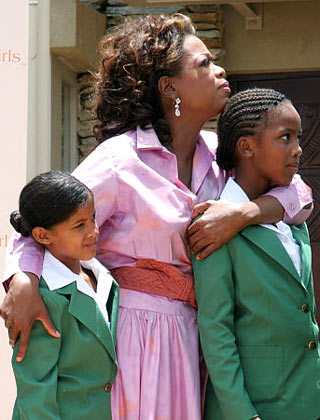 can keep a close eye on the school as it develops and evolves with time.
Read on for a few of the myriad accounts and opinions:
Wednesday, January 03, 2007
Upcoming trip to NYC - Chinatown and the LESTM

NYC - Chinatown: Manhattan Bridge Arch - Spirit of Commerce
Originally uploaded by wallyg.
I am looking forward to my trip to New York next weekend. Margot and Chris live in Brooklyn, and we are going to meet up earlier in the day to visit the Lower East Side Tenement Museum (LESTM). This is a really great social history museum that profiles the experiences of families that immigrated to the United States around the turn of the twentieth century. My goal for the afternoon is to learn some interesting facts and discuss strategies for teaching this immigration history so that it comes alive for the my Temple University students, many of whom are already from immigrant families.
I am already getting excited about the trip, and have been enjoying a virtual visit of the neigbhorhood. Wally G. has posted on Flickr a wonderful collection of photos taken from the mean streets of the Lower East Side and Chinatown. This photos, can be explored using Google Maps, allowing the user to map out their own itinerary. *Click* on the photo above, then *click* on the "map" link on the lower right in order to explore his collection in plan view!
Later that evening, we will all be attendng the reunion concert of the dB's and the Sneakers at the Bowery Ballroom. Sounds like fun, although I still haven't learned how to take satisfying concert pictures so you are just going to have to imagine the scene. Mike
Jamaica: Earning a quick dollar in the ghetto makeover
Linguist, journalist, blogger Ria Bacon shares a photo of women working on Barbican Road in Kingston, Jamaica as part of the annual city clean-up, spawned not so much by civic pride as by political clientelism. This item was brought to my attention by Global Voices.
Friday, December 29, 2006
Insights in to an Indian melting pot: Gujarat State
I have been enjoying learning more about the Gujarat region of India. Northwest of Mumbai and south of the Indus River and Pakistan, Gujarat enjoys an expanding economy. As more and more of the region benefits from economic globalization, we start to see a Gujarati presence on social networking websites such as Flickr. Get a taste of this new landscape by searching Flickr for "Gandhinagar," or visit the website for Infocity, Gandhinagar.
In the post-independence period, India had the challenge of creating capital cities that didn't celebrate authority and imperialism, but rather allowed for the growth of democratic values. Professor Ravi Kalia of City College, CUNY has recently published a book called that explores the difficulties that Gujarat State faced in designing its new regional capital Gandhinagar, responding to local cultures in the modernist architectural idiom. You may be interested in seeing a video lecture where he discusses these perspectives.
Photo bloggers such as Japan Pathak have been quite patriotic in sharing insights into this region through the internet. While the region is very hot and dry, during the rainy season we can also see flooding, as demonstrated in this photo posted on Flickr.

Sabarmati river flood in Ahmedabad - My one of the best click during flood 2006
Originally uploaded by japan pathak.
In the post-independence period, India had the challenge of creating capital cities that didn't celebrate authority and imperialism, but rather allowed for the growth of democratic values. Professor Ravi Kalia of City College, CUNY has recently published a book called that explores the difficulties that Gujarat State faced in designing its new regional capital Gandhinagar, responding to local cultures in the modernist architectural idiom. You may be interested in seeing a video lecture where he discusses these perspectives.
Photo bloggers such as Japan Pathak have been quite patriotic in sharing insights into this region through the internet. While the region is very hot and dry, during the rainy season we can also see flooding, as demonstrated in this photo posted on Flickr.
Sabarmati river flood in Ahmedabad - My one of the best click during flood 2006
Originally uploaded by japan pathak.
You may also be interested in checking out gujju rap's meditation on the modernist and traditionalist pulls that one finds in this region.
Subscribe to:
Posts (Atom)


